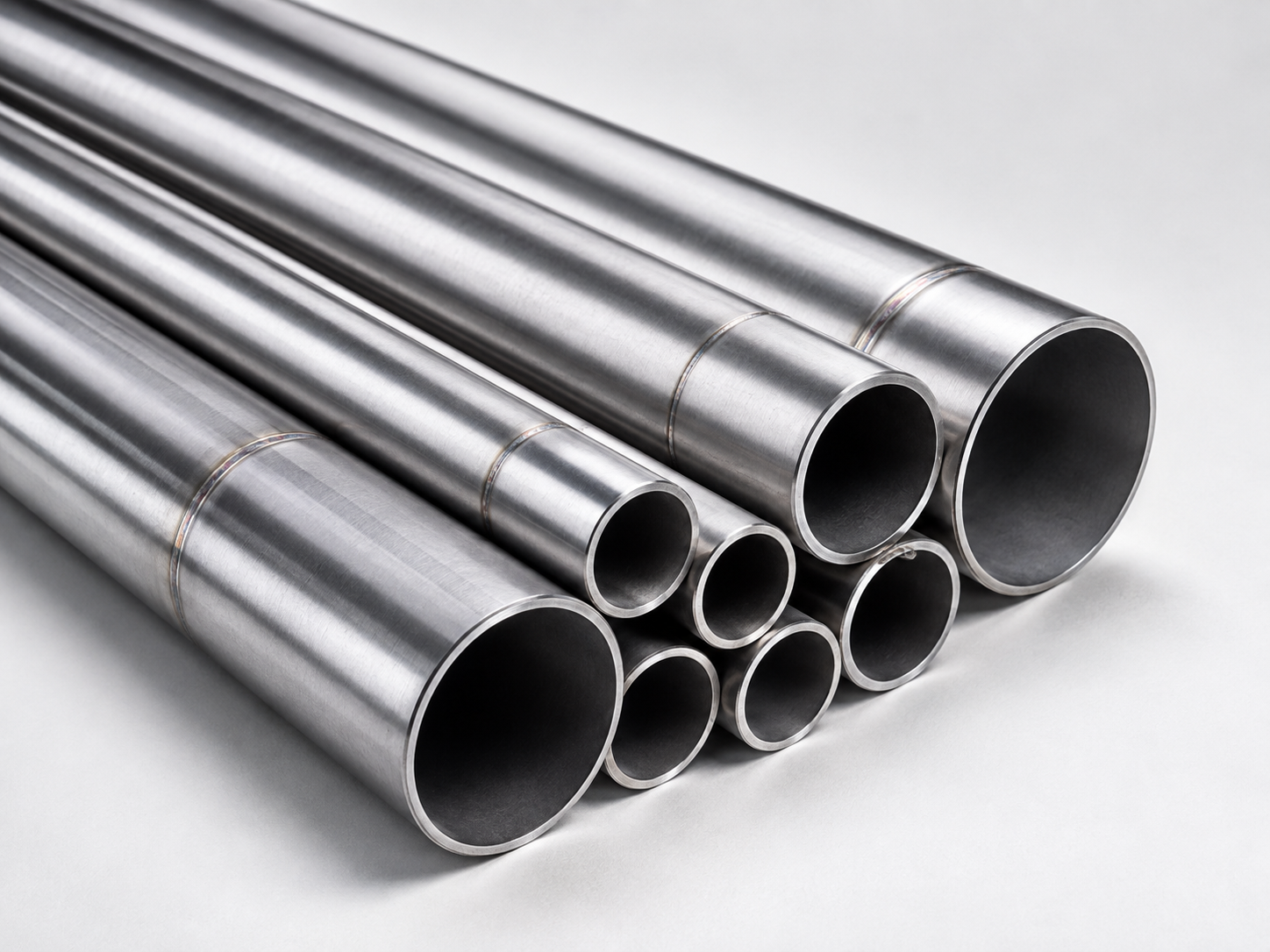
Buying ASTM B862 titanium welded pipe is not simply a matter of asking for “Grade 2 titanium pipe” and comparing price per kilogram. Welded pipe is a defined product route, and the purchasing specification should align the grade, dimensional basis, delivery condition, inspection scope, documentation and service requirements before suppliers quote.
ASTM International currently lists ASTM B862-23 as the active edition for titanium and titanium-alloy welded pipe. The specification is intended for general corrosion-resisting and elevated-temperature service and covers multiple titanium grades, including Grade 1, Grade 2, Grade 9 and Grade 12. ASTM also notes that welded pipe is made from annealed flat-rolled products by a welding process and may be further reduced by cold or hot working.
What Does ASTM B862 Cover?
ASTM B862 is a material and product specification for titanium and titanium-alloy welded pipe. ASTM describes its service scope as general corrosion-resisting and elevated-temperature applications. The current ASTM listing identifies 33 grades and defines chemical-composition and mechanical-property requirements for the covered materials. Buyers can check the current standard listing at ASTM International.
For procurement teams, the most important first distinction is product form. If the engineering document requires ASTM B862, the quotation should be based on welded pipe. A supplier should not silently substitute seamless ASTM B861 pipe, and a buyer should not use a heat-exchanger tube standard simply because the dimensions look similar.
| Procurement item | What to define before requesting price |
|---|---|
| Product form | Titanium welded pipe |
| Governing standard | ASTM B862 plus the project-required edition and customer specification |
| Grade | Exact titanium grade / UNS when required by drawing or material specification |
| Dimensions | NPS or OD, wall thickness / schedule, finished length and tolerance basis |
| Quantity | Pieces, total meters or project lot quantity |
| Delivery condition | Condition required by the grade, standard and project specification |
| Inspection | Base specification requirements plus any project-specific NDT, witness or hold points |
| Documents | MTC, dimensional report, inspection records and project certificates |
| Service data | Fluid, concentration, temperature, design pressure and corrosion environment |
Large-diameter buyer note: ASTM states that pipe 8 in. NPS and larger is most frequently custom made for an order. For these sizes, the purchaser should carefully review the specification’s applicability and may select a wall thickness suited to the operating conditions. This is a strong reason to send the actual design requirement rather than asking only for a generic “8-inch titanium pipe price.”
ASTM B862 vs ASTM B861: Welded Pipe or Seamless Pipe?
ASTM B862 and ASTM B861 are closely related in buying conversations because both can be used for corrosion-resistant titanium piping, but they define different manufacturing routes. ASTM B862 is welded pipe; ASTM B861 is seamless pipe. The engineering specification—not unit price alone—should determine which route is acceptable.
| Buyer question | ASTM B862 | ASTM B861 |
|---|---|---|
| Product route | Welded titanium / titanium-alloy pipe | Seamless titanium / titanium-alloy pipe |
| Typical procurement reason | Project piping, larger diameters, corrosion-resistant transfer lines and welded-pipe designs | Projects that explicitly require seamless construction |
| Starting material / route | Annealed flat-rolled product formed and welded; further hot/cold reduction may be used | Seamless manufacturing route |
| Main RFQ risk | Not specifying weld-related inspection or delivery condition when the project requires it | Allowing a welded substitution when seamless construction is mandatory |
| Related TAILIDEXIN page | Titanium Welded Pipe | Titanium Seamless Pipe |
If your drawing calls for seamless titanium pipe, use our ASTM B861 titanium seamless pipe buyer guide. Keeping the B861 and B862 inquiries separate makes supplier comparisons cleaner and reduces the risk of receiving quotations for different manufacturing routes.
Grade Selection: Gr1, Gr2, Gr9 and Gr12 in an ASTM B862 RFQ
The standard covers many titanium grades, but the correct grade should come from the project material selection, corrosion review and design requirements. TAILIDEXIN’s current welded-pipe product range highlights Gr1, Gr2, Gr9 and Gr12 because they represent distinct procurement conversations rather than interchangeable “quality levels.”
| Grade | Material description in ASTM listing | Procurement discussion |
|---|---|---|
| Grade 1 / UNS R50250 | Unalloyed titanium | Used where the project specifically selects the lower-strength commercially pure grade; do not substitute solely on availability. |
| Grade 2 / UNS R50400 | Unalloyed titanium | A common commercial procurement grade, but service chemistry, fabrication and design requirements still need confirmation. |
| Grade 9 / UNS R56320 | Titanium alloy with approximately 3% Al and 2.5% V | Use only when the project requires Grade 9 properties and fabrication route; it is not a generic upgrade from Grade 2. |
| Grade 12 / UNS R53400 | Titanium alloy containing Mo and Ni | Often enters corrosion-service discussions where the engineering specification specifically calls for Gr12. |
Delivery condition matters when comparing grades
The ASTM B862-23 listing distinguishes delivery conditions by grade. For example, Grades 1 and 2 may be furnished welded or annealed, while Grade 12 is furnished annealed and Grade 9 is furnished annealed. Purchasing teams should therefore avoid writing one generic delivery-condition line for every grade. If a project drawing, welding procedure, downstream forming operation or customer specification imposes a particular condition, state it directly in the RFQ.
Material-selection note: Grade choice should not be made from a blog table alone. Chloride concentration, temperature, pH, oxidizing/reducing conditions, crevices, deposits, galvanic couples, cleaning chemicals, fabrication details and design stress can all affect material suitability.
How Welded Titanium Pipe Is Purchased: Manufacturing Route and QA Questions
ASTM’s current B862 description states that welded pipe is made from annealed flat-rolled products by a welding process. It may then be further reduced by cold working or hot working. That manufacturing route creates several practical buyer questions that do not arise in exactly the same way when purchasing seamless pipe.
1. Confirm the product route, not only the finished dimensions
Two pipes can have the same OD and wall thickness but different manufacturing routes. If the PO calls for ASTM B862, make sure the quotation, MTC and identification all correspond to welded pipe. Where the project allows either welded or seamless material, request separate commercial options instead of leaving the manufacturing route ambiguous.
2. Define weld-related project requirements before quotation
The base material standard and the project quality plan are not always identical. If the customer requires weld-procedure documentation, welder/operator qualification records, visual acceptance criteria, surface examination, radiographic or ultrasonic examination, penetrant examination, or a specific inspection frequency, write those requirements into the RFQ. Do not assume every supplier will include project-specific NDT in a base ASTM B862 price.
3. Treat supplementary inspection as a commercial requirement
ASTM B862 provides optional supplementary requirements for cases where a greater degree of testing is desired. ASTM specifically notes that the purchaser may invoke supplementary requirements in the order. From a buying perspective, this means additional inspection should be quoted before the PO is placed, because it can affect production routing, third-party coordination, document workload, lead time and price.
| QA question | Why the buyer should define it |
|---|---|
| Is the route explicitly ASTM B862 welded pipe? | Prevents comparison against seamless or tube products with a different compliance basis. |
| What delivery condition is required? | Some grades have specific furnished conditions under the standard and project documents may add requirements. |
| Is additional weld NDT required? | Project-specific RT/UT/PT or other examination can change cost and lead time. |
| Are supplementary tests required? | ASTM allows purchasers to invoke additional supplementary requirements when a greater degree of testing is desired. |
| Is third-party inspection required? | Hold points and witness points need to be scheduled before shipment. |
| What traceability is required? | Heat/lot identification, MTC linkage and marking should match the customer quality plan. |
Dimensions, Wall Thickness and Length: What to Put on the Purchase Line
“Titanium welded pipe, 100 mm” is not a complete size description. A purchasing line should make the dimensional basis unambiguous. Depending on the project, the controlling data may be NPS and schedule, exact outside diameter and nominal wall, minimum wall thickness, or drawing-specific dimensions.
| Dimensional field | Buyer instruction |
|---|---|
| NPS / outside diameter | State whether the design is controlled by nominal pipe size or actual OD. |
| Wall thickness | Identify schedule, nominal wall or minimum wall and the applicable tolerance basis. |
| Length | Specify random or fixed length; for fixed lengths, state tolerance and cut-end condition. |
| End preparation | Plain, square cut, beveled or project-specific preparation. |
| Straightness / roundness | Include project limits when tighter than the base purchase specification. |
| Surface / cleanliness | State any pickling, cleaning, contamination-control or special surface requirement. |
| Marking | Define grade, heat/lot, standard and customer marking requirements. |
Large-diameter welded pipe is especially important to specify correctly because fabrication and commercial routing can be order-specific. If the project uses a custom wall thickness, include the design drawing or line-class excerpt rather than asking suppliers to infer the correct wall from the nominal diameter.
Inspection, Certificates and Documentation for International Orders
ASTM B862 requires the covered materials to conform to chemical-composition and mechanical-property requirements. The current ASTM scope also highlights optional supplementary requirements where the purchaser wants a greater degree of testing. In practice, an international buyer should separate standard compliance from project additions in the RFQ.
| Inspection / document | What to clarify in the RFQ |
|---|---|
| Material certificate / MTC | Grade, heat/lot traceability, reported chemistry and mechanical data required by the PO. |
| Dimensional inspection | OD/NPS, wall thickness, length and drawing-specific checks. |
| Delivery condition | Confirm the required furnished condition for the selected grade and project. |
| Weld examination | Identify any project-specific visual, PT, RT, UT or other weld-inspection requirement and frequency. |
| Supplementary testing | List every optional test or customer acceptance requirement before quotation. |
| PMI | State whether positive material identification is required and what procedure/report is expected. |
| Third-party inspection | Name the agency, witness/hold points and document-review scope. |
| Export documents | State packing list, origin, inspection, marking or customer-specific document requirements. |
Do not add substantial inspection requirements after price confirmation unless the supplier has reviewed their effect. A quote based on standard production plus MTC is not commercially equivalent to a quote that also includes additional weld NDT, third-party witness and a customer-specific inspection dossier.
Procurement Table: ASTM B862 Titanium Welded Pipe RFQ Template
The following format helps buyers send the same technical requirement to every supplier. The values in the example column are examples of formatting only; replace them with the actual project requirement.
| RFQ field | What to specify | Example format |
|---|---|---|
| Product | Welded titanium pipe | Titanium welded pipe |
| Standard | ASTM B862 + project-required edition/specification | ASTM B862 |
| Grade | Exact grade / UNS if required | Gr2 / UNS R50400 |
| Size | NPS or actual OD | NPS 8 or OD as drawing |
| Wall | Schedule, nominal wall or minimum wall | 6.0 mm nominal |
| Length | Random or fixed length + tolerance | 6,000 mm fixed |
| Quantity | Pieces / meters / project lot | 80 pcs |
| Delivery condition | Condition required by standard/project | Annealed where required |
| Ends | Plain / bevel / square / drawing requirement | Plain ends, deburred |
| Service | Fluid, concentration, temperature, pressure, application | Corrosion-resistant process line |
| Inspection | ASTM requirements + project NDT/supplementary testing | Per ASTM B862 + PO additions |
| Documents | MTC, dimensional report, weld/NDT reports if required | MTC + dimensional report |
| Packing | Export packing, end protection and marking | Seaworthy export packing |
| Commercial terms | Incoterm, destination and requested delivery | FOB / CIF + destination port |
Eight Common Titanium Welded Pipe Buying Mistakes
- Writing only “titanium welded pipe.” The grade, ASTM standard, size, wall and delivery condition still need to be defined.
- Confusing ASTM B862 with ASTM B861. One is welded pipe and the other is seamless pipe; do not compare them as if manufacturing route were irrelevant.
- Using ASTM B338 for ordinary process-pipe purchasing. B338 is associated with condenser, evaporator and heat-exchanger tube, so confirm the intended product form.
- Leaving the weld-inspection scope undefined. If project-specific NDT is required, put it in the RFQ before commercial comparison.
- Ignoring the delivery condition for the selected grade. Grade-specific furnished conditions should match the standard and project specification.
- Ordering large diameter by nominal size alone. For custom pipe, send the exact wall, length, end preparation and drawing requirements.
- Adding third-party inspection after production starts. Witness points and document review need to be incorporated into the production plan.
- Comparing only unit price. Compare standard, grade, manufacturing route, inspection, certificate scope, usable length, packing, delivery and commercial terms together.
Related Titanium Products and Procurement Guides
FAQ: ASTM B862 Titanium Welded Pipe
What is ASTM B862 used for?
ASTM B862 is the specification for titanium and titanium-alloy welded pipe intended for general corrosion-resisting and elevated-temperature service. The purchase order should identify the project-required edition and any additional customer requirements.
Is Grade 2 titanium covered by ASTM B862?
Yes. ASTM B862-23 includes Grade 2 / UNS R50400, along with Grade 1, Grade 9, Grade 12 and many other titanium grades.
What is the difference between ASTM B862 and ASTM B861?
ASTM B862 covers welded titanium pipe, while ASTM B861 covers seamless titanium pipe. Use the manufacturing route required by the engineering specification rather than selecting solely by price.
How is ASTM B862 welded pipe manufactured?
ASTM’s current description states that the pipe is made from annealed flat-rolled products by a welding process and may be further reduced by cold working or hot working.
Why is 8-inch NPS important in ASTM B862 procurement?
ASTM notes that pipe 8 in. NPS and larger is most frequently custom made for an order. Buyers should therefore define the actual wall thickness, operating requirements and project acceptance criteria instead of relying on a generic size description.
Does ASTM B862 allow additional testing?
Yes. ASTM states that optional supplementary requirements are available when a greater degree of testing is desired, and the purchaser may invoke them by specifying them in the order.
What information should I send for a Grade 2 titanium welded pipe quotation?
Send ASTM B862, grade, NPS or OD, wall thickness, length, quantity, delivery condition, end preparation, service conditions, inspection/NDT requirements, documentation, packing and destination.
Can TAILIDEXIN review a custom welded-pipe RFQ?
Yes. Send the project standard, grade, exact dimensions, quantity, service conditions and inspection scope. TAILIDEXIN can review the requested configuration and confirm the quotation basis before pricing.
Request an ASTM B862 Titanium Welded Pipe Quotation
Send TAILIDEXIN your ASTM standard, titanium grade, NPS/OD, wall thickness, finished length, quantity, delivery condition, service conditions, weld/NDT requirements, documentation and destination. A complete RFQ makes supplier quotations easier to compare and reduces re-quoting.
Technical information in this article is intended to support procurement communication. Final material selection, pressure design, corrosion suitability, code compliance, weld acceptance and inspection criteria should follow the project engineer, applicable code, current standard edition and purchase specification.