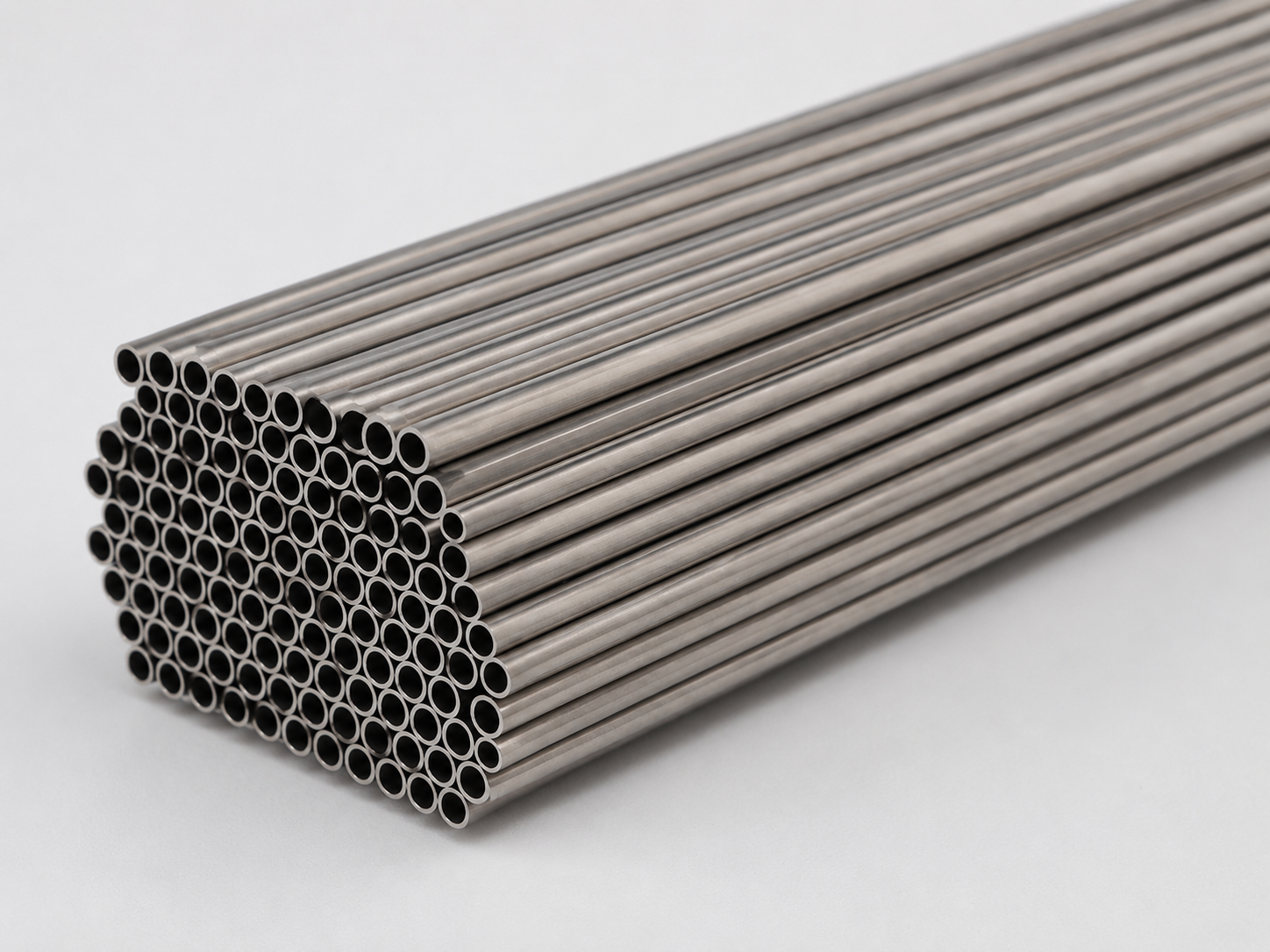
Titanium pipe for seawater is widely considered where chloride exposure, reliability and long equipment life matter more than the lowest initial material price. Seawater cooling loops, thermal desalination units, condensers, evaporators, offshore systems and chemical plants can all contain titanium piping or tubing. But a quotation request that says only “Grade 2 titanium pipe for seawater” still leaves important technical and commercial questions unanswered.
For an international buyer, the procurement task is to define the service conditions, select the correct product standard, identify whether Grade 2 or another approved titanium grade is required, and state the inspection and document package before comparing suppliers. This guide focuses on titanium pipe for desalination plants, seawater cooling systems and brine service. It is a procurement guide rather than a corrosion-design approval: the final grade and design limits must be confirmed by the project engineer, owner specification and applicable code.
Quick RFQ Summary: What to Send for Titanium Seawater Piping
| RFQ item | What the buyer should state | Why it changes the quotation |
|---|---|---|
| Service | Seawater, brine, chlorinated seawater, cooling water, RO feed/reject, condenser water or other fluid | “Seawater” alone does not define temperature, oxygen level, solids, chemistry or crevice risk |
| Operating data | Normal/design temperature, pressure, concentration/salinity, pH and upset conditions | Grade selection and engineering review depend on the complete environment |
| Product form | Seamless pipe, welded pipe, heat exchanger tube, fittings, flanges or plate | Different forms use different ASTM specifications and manufacturing routes |
| Titanium grade | Gr2 / UNS R50400, Gr12 / UNS R53400, or project-approved grade | Prevents unapproved substitutions and clarifies corrosion/design basis |
| Standard | ASTM B861, B862, B338, B363, B381 as applicable | Defines the product specification, tests and acceptance framework |
| Dimensions | NPS or OD, wall/schedule, fixed/random length, ends and tolerance | Affects material availability, manufacturing route, yield and freight |
| Inspection | Standard tests plus any PMI, NDT, third-party inspection, witness/hold points | Additional inspection can materially affect lead time and cost |
| Documents | MTC, heat/lot traceability, dimensional report, test reports, EN 10204 3.1 if required by PO | The certificate package should be priced and agreed before production |
Why Is Titanium Used in Seawater Systems?
Titanium develops a stable, tightly adherent oxide film that reforms in the presence of oxygen and water. That passive film is the reason commercially pure titanium has a long industrial history in seawater, brackish water, condensers and desalination equipment. Technical literature from the International Titanium Association describes strong general-corrosion performance of commercially pure titanium in seawater and points to localized crevice conditions—not uniform wall loss—as one of the more important design checks at elevated temperature.
For procurement teams, this distinction matters. A buyer should not simply ask whether titanium “resists seawater.” The useful question is whether the selected grade is approved for the project’s temperature, pH, oxygen condition, crevice geometry, chlorination, solids and galvanic design. The same material may perform very differently in a cool, well-aerated open line than in a hot, tightly gasketed and poorly aerated brine crevice.
Commercial reasons buyers consider titanium
- Corrosion allowance can often be reduced compared with materials that rely on sacrificial wall thickness, subject to the project design basis.
- Low density can reduce installed weight for large pipe, tube bundles and fabricated assemblies.
- High allowable seawater velocity in suitable designs can support compact piping and heat-transfer systems, although solids and impingement still require review.
- Long service experience in seawater condensers and desalination supports life-cycle purchasing decisions when downtime is expensive.
- Welded thin-wall products can be economically attractive in large heat-transfer surfaces and selected piping sizes.
Screening data in industry literature should not be used as a project design limit. The owner/EPC corrosion engineer should approve the grade, joint design, temperature and operating envelope.
Where Is Titanium Used in Desalination and Seawater Projects?
“Desalination” covers different process routes. Thermal plants and reverse-osmosis plants do not use the same materials in the same places, so a supplier needs to know the equipment tag and fluid duty rather than only the plant type.
| Application | Typical titanium product | Buyer focus |
|---|---|---|
| Seawater intake / transfer | Seamless pipe or welded pipe | Size, wall, flow velocity, solids, flange/joint design, chlorination |
| Seawater cooling loop | Pipe, elbows, tees, reducers, flanges | System grade consistency, galvanic interfaces, NDT and hydrotest requirements |
| Surface condenser / cooler | ASTM B338 heat exchanger tube | OD, wall, length, tube type, eddy current/UT or pressure test route, tube-sheet interface |
| MSF / MED thermal desalination | Heat exchanger tube, pipe, fittings and fabricated titanium components | Hot brine temperature, crevice areas, oxygen condition, chemistry and cleaning cycles |
| RO desalination | Selected high-risk seawater components rather than necessarily the complete plant | Actual location, pressure, chloride exposure, pump/valve interfaces and owner material specification |
| Brine discharge / recycle | Pipe and fittings where titanium is specified | Concentration, temperature, pH, aeration and upset chemistry |
Thermal desalination generally creates a stronger use case for titanium heat-transfer surfaces because hot seawater and brine contact large condenser and evaporator areas. Reverse-osmosis systems may use titanium more selectively. This is why an RFQ should identify the tag number, fluid and equipment function instead of using “desalination plant” as the only service description.
Grade 2 vs Grade 12 Titanium for Seawater
Grade 2 titanium (UNS R50400) is a commercially pure grade and is commonly used as a baseline material for seawater pipe, condenser tubing and general corrosion-resistant fabrication. Grade 12 titanium (UNS R53400) contains nickel and molybdenum additions and is often considered when the service has a more demanding localized-corrosion or crevice-corrosion envelope.
Grade 12 is not automatically “better” for every seawater purchase. If the owner specification approves Grade 2 for a cool, aerated seawater line, changing to Grade 12 can increase cost and reduce sourcing flexibility without solving a defined problem. Conversely, an elevated-temperature brine system with tight crevices, low pH or reduced oxygen should not be downgraded to Grade 2 simply to save purchase cost.
| Selection point | Grade 2 | Grade 12 |
|---|---|---|
| Material type | Commercially pure titanium, UNS R50400 | Ti-Ni-Mo alloy, UNS R53400 |
| Typical purchasing role | Common baseline for many seawater and chloride-service applications | More demanding corrosion/crevice environments where project engineering requires additional margin |
| Availability | Generally broad across pipe, tube, plate and fittings | May require more planning depending on form, size and quantity |
| Cost | Usually lower alloy cost and broader sourcing | Typically higher material cost |
| Use decision | Choose when approved by the service corrosion review | Choose when the service/design basis requires its improved localized-corrosion performance |
Industry corrosion literature reports that unalloyed titanium can become more sensitive to tight-crevice attack as temperature rises or pH falls, while Grade 12 extends the useful crevice-corrosion envelope in chloride brines. Treat such data as a screening tool, not a substitute for the project corrosion study.
For a broader grade comparison, see our Grade 2 vs Grade 12 titanium procurement guide.
Which ASTM Standard Should a Seawater Titanium RFQ Use?
One piping package can contain multiple titanium product forms, and each form can require a different standard. Using “ASTM titanium pipe” without identifying the standard is not sufficient.
| Product | Current ASTM reference used in this guide | Procurement purpose |
|---|---|---|
| Seamless titanium pipe | ASTM B861-24 | Seamless titanium and titanium alloy pipe for general corrosion-resisting and elevated-temperature service |
| Welded titanium pipe | ASTM B862-23 | Welded titanium and titanium alloy pipe; purchaser may invoke supplementary requirements where needed |
| Condenser / heat exchanger tube | ASTM B338-17(2026) | Seamless and welded titanium tubes for condensers, evaporators and heat exchangers |
| Welding fittings | ASTM B363-23 | Elbows, tees, reducers, caps, returns and other titanium welding fittings |
| Forged components / flange material | ASTM B381-26 | Titanium and titanium alloy forgings; project flange dimensions/class still need to be specified separately |
As of September 2026, ASTM lists B861-24 for seamless pipe, B862-23 for welded pipe, B338-17(2026) for condenser/heat-exchanger tube, B363-23 for welding fittings and B381-26 for titanium forgings. The purchase order should identify the revision required by the project rather than assuming the supplier will choose it.
Pipe and heat exchanger tube are not interchangeable terms
One of the most common RFQ problems is asking for “titanium pipe” while providing a condenser tube size. If the product is installed as a heat-transfer tube bundle, ASTM B338 may be the correct purchasing route. If it is process piping, B861 or B862 may apply. The dimensional basis, tests and manufacturing route differ, so clarify the equipment function before quotation.
Service Data That Can Change Grade or Piping Design
A material supplier should not approve corrosion performance from one word such as “seawater.” A good buyer RFQ provides enough process data for the owner/EPC and supplier to identify questions before the purchase order.
1. Temperature and pH
General seawater corrosion resistance is only part of the design problem. Elevated temperature and lower pH can increase localized-corrosion concern in tight crevices. State the normal, maximum and design temperature, not only ambient conditions. For desalination brine, include both bulk pH and any chemical cleaning or dosing condition that can temporarily change pH.
2. Oxygen condition and stagnant crevices
Titanium’s passive film benefits from oxidizing conditions. Tight gasket faces, deposits, dead legs and stagnant zones can have a different local chemistry from the main flowing stream. If the system has long shutdown periods, low-flow operation or inaccessible crevices, include that information in the materials review.
3. Chlorination, oxidants and cleaning chemicals
Seawater systems often use chlorination or other treatment chemistry for biofouling control. Desalination plants can also use acid/alkaline cleaning chemicals. Give the dosing concentration, frequency, duration and maximum temperature. A cleaning cycle can be more aggressive than normal operation.
4. Suspended solids, sand and impingement
Titanium has strong erosion-corrosion performance in flowing seawater, but a pipe elbow receiving high-velocity sand-laden flow is not the same duty as a clean condenser tube. State the expected solids, particle size if known, velocity range and any direct-impingement location.
5. Galvanic interfaces
Titanium is relatively noble in seawater. When it is connected to less noble metals, the other metal can become the galvanic corrosion concern. The piping package should therefore identify mating flanges, tubesheets, valves, pumps, fasteners and electrical-isolation requirements. Do not leave material-interface decisions until installation.
6. Cathodic protection and hydrogen risk
Systems with impressed-current or sacrificial-anode cathodic protection require engineering review because excessive cathodic polarization can create hydrogen-related concerns for titanium under certain conditions. Include cathodic-protection data when the titanium is electrically connected to the protected system.
Dimensions, Lengths and End Preparation to Put on the PO
The product standard does not replace the dimensional purchase description. Buyers should define whether the requirement is based on NPS/schedule or exact OD × wall thickness, because titanium supply can be produced or stocked under different dimensional conventions.
| Dimension item | Pipe RFQ example | Heat exchanger tube RFQ example |
|---|---|---|
| Size basis | NPS 4 or OD 114.3 mm | OD 19.05 mm |
| Wall | Schedule / nominal wall or exact wall thickness | 0.7 mm wall |
| Length | 6,000 mm fixed length or stated random length | 8,000 mm fixed tube length |
| End | Plain, beveled or project-specific preparation | Cut square / deburred as specified |
| Quantity | Pieces, meters and total estimated weight | Number of tubes plus spare percentage |
| Tolerance | Applicable ASTM/project dimensional tolerances | OD, wall and length tolerance required for tube-sheet fit |
Large welded titanium pipe, unusual wall thicknesses and long fixed lengths may be made to order. Give the supplier the complete size list at the RFQ stage so the quotation can reflect realistic mill yield, weld count, inspection and packaging.
QA, Testing and Documentation for Seawater Titanium
Inspection should be tied to the actual ASTM product standard and project quality plan. Adding generic phrases such as “100% NDT” without defining the method, acceptance criteria and reporting requirement can create commercial disputes.
- Material test certificate: require heat/lot identification, chemistry and mechanical properties applicable to the ordered specification.
- Traceability: define marking and transfer of heat/lot identity through cutting, forming and packaging.
- Dimensional inspection: specify the report format where OD, wall, length, ovality or fitting geometry must be documented.
- Pressure / NDT: use the tests required by the applicable standard and add project-specific supplementary examination only where needed.
- PMI: state whether positive material identification is required, for which items, and whether buyer/third-party witnessing is needed.
- Surface and cleanliness: define pickled, polished or as-manufactured surface where relevant; prevent carbon-steel contamination during handling and fabrication.
- Third-party inspection: specify agency, inspection level, hold/witness points and document approval timing before production.
- Certificate format: request EN 10204 3.1 or another certificate format only if required by the purchase specification.
ASTM B338 has product-specific test routes for welded and seamless heat-exchanger tubing, while B861 and B862 have their own pipe requirements. Do not copy a tube inspection clause into a pipe purchase order without checking applicability.
Complete RFQ Table for Titanium Pipe in Seawater or Desalination Service
| Field | Information to provide |
|---|---|
| Project / equipment | Plant name, equipment tag, seawater intake, cooling loop, condenser, evaporator, RO area, brine line, etc. |
| Fluid | Natural seawater / brackish water / concentrated brine / RO feed or reject / treated or chlorinated seawater |
| Chemistry | Salinity/chloride if known, pH, oxidants, cleaning chemicals and contaminants |
| Temperature | Normal, maximum, design and cleaning temperature |
| Pressure | Operating and design pressure; test pressure if project-specific |
| Flow | Normal/max velocity, solids/sand, stagnant periods and impingement locations |
| Grade | Gr2 / UNS R50400, Gr12 / UNS R53400, or owner-approved alternative |
| Product standard | ASTM B861 / B862 / B338 / B363 / B381 and revision required |
| Dimensions | NPS/OD, wall/schedule, length, ends, tolerance, fitting/flange size and pressure class where applicable |
| Quantity | Pieces, meters, sets, spare quantity and total package split |
| Testing | Base standard tests plus specified UT/ET/RT/PT/PMI/hydro/pneumatic or supplementary requirements as applicable |
| Documentation | MTC, traceability list, dimensional report, test reports, NDT reports, certificate format, third-party inspection dossier |
| Packaging | Seaworthy export packing, end caps, bundle/crate requirement, identification and destination port |
| Commercial | Incoterm, destination, required delivery date, partial shipment acceptance and quotation validity |
Need a Titanium Seawater Pipe or Tube Quotation?
Send the grade, ASTM standard, size, wall thickness, length, quantity, seawater/brine service conditions and inspection requirements. If your material grade is not yet fixed, send the owner/EPC material specification so we can quote the specified product route rather than guess the corrosion design.
Common Titanium Seawater Purchasing Mistakes
Ordering “Grade 2 pipe” without a product standard
This leaves seamless vs welded construction, inspection route and dimensional requirements unclear. Specify ASTM B861 or B862 for process pipe, or B338 when the product is heat exchanger tubing.
Using a general seawater claim as a corrosion guarantee
Temperature, crevices, oxygen, pH, chlorination, cleaning and galvanic design still matter. Material approval belongs in the project corrosion/materials review.
Automatically upgrading every line to Grade 12
Grade 12 can be valuable in more demanding service, but it should solve a defined corrosion/design requirement. An unnecessary alloy upgrade can increase purchase cost and lead time.
Ignoring fittings and flange material until after pipe quotation
A piping package should be reviewed as a system. Pipe, elbows, reducers, stub ends, flanges, gaskets and mating materials influence both procurement and corrosion design.
Comparing quotations with different QA scope
One supplier may price base ASTM testing while another includes third-party inspection, extra NDT and detailed reports. Normalize the inspection and document scope before comparing unit price.
Frequently Asked Questions
Is Grade 2 titanium suitable for seawater piping?
Grade 2 is widely used in seawater service and is a common baseline grade for corrosion-resistant piping and heat-transfer applications. Suitability for a specific project still depends on temperature, pH, aeration, crevice geometry, galvanic interfaces, treatment chemistry and the owner/EPC material specification.
When should a buyer consider Grade 12 instead of Grade 2?
Grade 12 is often considered where the corrosion review identifies a more demanding localized- or crevice-corrosion environment, such as higher temperature or more aggressive brine conditions. The project engineer should define the required grade rather than relying on a generic temperature rule.
Which ASTM standard covers titanium pipe for seawater?
ASTM B861 covers seamless titanium pipe and ASTM B862 covers welded titanium pipe. Heat exchanger tubing is generally ordered to ASTM B338, titanium welding fittings to ASTM B363, and titanium forgings can be ordered to ASTM B381 where applicable.
Is ASTM B338 pipe or tube?
ASTM B338 is a tube specification for seamless and welded titanium tubes used in condensers, evaporators and heat exchangers. Process piping should normally be evaluated under the appropriate pipe specification rather than called B338 pipe.
Is titanium used in reverse-osmosis desalination plants?
It can be used, but not every RO system requires titanium throughout. Titanium may be selected for specific seawater-exposed or high-reliability components. Buyers should identify the exact equipment location and owner material specification.
What information is most important for a desalination titanium RFQ?
Provide the fluid duty, salinity/chloride if known, pH, temperature, pressure, treatment chemistry, product form, grade, ASTM standard, dimensions, quantity, inspection plan, document package and destination.
Can seamless and welded titanium pipe be mixed in one project?
Yes, if the project specification permits both routes for the relevant sizes and duties. The purchase order should identify which line items are B861 seamless and which are B862 welded so quotations remain comparable.
What documents should be requested with titanium seawater piping?
A typical project may require an MTC, heat/lot traceability, dimensional inspection records and product-standard test reports. PMI, NDT, third-party inspection or EN 10204 3.1 should be added when the project specification requires them.
Related Titanium Products and Buyer Guides
Standards and revisions referenced in this article were checked for publication on September 9, 2026. Purchase orders should use the revision required by the project specification and verify current status before release.